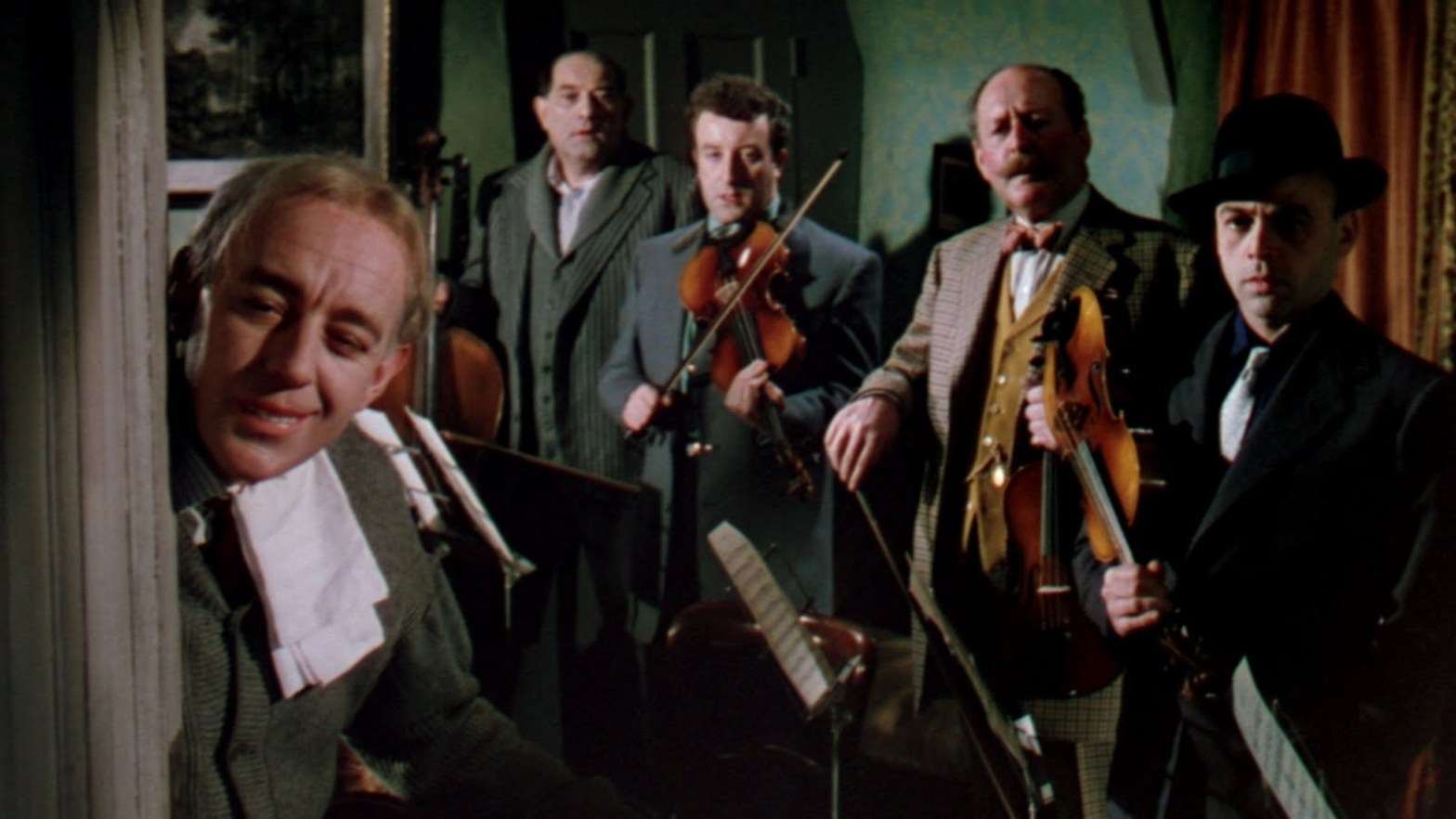
The Ladykillers is one of the great comedies, and comedies are a hard thing to pull off. Why is this so? Since the primary aim of comedy is to let you give yourself up to laugher for a few hours, albeit such an aim does not preclude the inclusion of deeper currents of thought, there is a danger that the comedy will never develop enough depth to withstand a slowing of the comedic pace. That there are very few films which elicit continuous laugher throughout is sign enough that comedy itself is a fickle vehicle for a movie; a comedy driven by laugher alone cannot sustain momentum through its less raucous scenes. Look at modern comedies: how many of them fall flat after twenty minutes? Nearly all of them. Their problem is that although they have a promising premise, they lack a structure which permits the divorcing of character and plot development from laughter; when the laugher becomes sporadic to make room for development, they stall. Structure and pacing are paramount in comedy, which may explain in some way why we speak of comedic timing but never of tragic timing.
The Ladykillers is one of the great comedies because of its structure: its laughs are as golden as they come, as good as those in its more famous cousin, Arsenic and Old Lace, but its structure is what sets it apart. The film runs for ninety minutes, and if you divide it in half and then roughly into fifteen minutes segments you can see the carefully constructed foundation upon which it builds its laughs. It is at the halfway point in the film that it takes a sinister turn, turning from a light comedy to a dark one. Of course, the characters are the same, and sinister, in the second half, but instead of having robbery in mind they have murder. Here is a chart in which the movie is broken in half and sixths:
| 1st | 2nd | 3rd |
| Intro to Situation | ||
| Conflicts introduced (lighthearted) | Climax: Robbery | |
| Boccherini | Boccherini | |
| In the house, odd angles | ||
| ends with unitive roof scene | ||
| Begins with separation of antagonists | ||
| 4th | 5th | 6th |
| Intro to situation | ||
| Conflict Introduced (hard-edged) | Climax: Murder | |
| 2nd musical piece | 2nd musical Piece | |
| In the house, muffled angles | ||
| ends with divisive roof scene | ||
| Begins with separation of antagonists | ||
This structure is not perfectly rigid, but the exceptions to it highlight the unity of the parts. Take, for instance, the Boccherini theme which plays continually in the lighthearted 2nd and 3rd parts, is identified at the halfway point by the old lady of the house, Mrs. Wilberforce, and then never heard again until the end where it takes on a maniacal form. Again, the frightening aspect of Alec Guinness’s character is present, but played for laughs, in the first moments of the film although it properly belongs to the darker 2nd half where it helps define the mood.
One particularly brilliant move the film makes is having the same sets of antagonists in the first and second part and tying the two conflicts together causally. When the first conflict turns from trying to use a clueless old lady as an unwitting accomplice for a robbery to trying to kill her, the second conflict turns from questioning what sort of faith a man of action can put in such a plan to how to escape from the ghoulish brain who came up with the plan to begin with. Whereas the music and setting of the scenes unify the parts which are separated temporally, the unity of the different narrative threads is achieved by the causal connection between them.
As you watch this movie you may not really see the structure, you may be laughing too much to notice it beyond the abrupt dropping of the Boccherini theme, but it is the form on which the movie rests. Whether this brief description of that form is enough to make you watch the movie only you can say—I’ve yet to meet someone who watched a comedy for its structure. Watch it for its laughs, but be thankful that someone once put so much effort into giving you something to unwind to.
 Great Catholic Movies